Wednesday, October 3, 2012

Food Storage Survival Kits Available

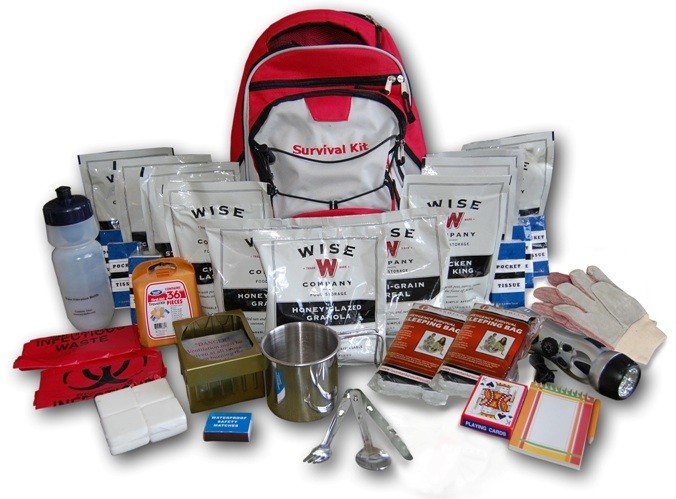
This Long Term Food Storage Essentials Kit has all of the food and supplies you will need to keep you safe for an extended period of time. There are 44 Long Term Food Storage Meals in this kit that will feed 1 Person for 14 days or 2 People for 1 Week. It is all packaged in our large Hikers Backpack.

This kit contains the following:

Food and Water: The food and water in this kit will comfortably provide you with adequate nutrition for 72-hours without access to additional supplies. These products have a 5 year shelf life.
11 Cook in the Pouch Meals with a total of 44 meals:

• 28 - Lunch/Dinner Servings
o Stroganoff - 4 Servings (1 Pouch)
o Creamy Chicken Pasty - 4 Servings (1 Pouch)
o Cheesy Lasagna - 4 Servings (1 Pouch)
o Chicken Teriyaki - 4 Servings (1 Pouch)
o Chicken Ala King - 4 Servings (1 Pouch)
o Southwest Bean & Rice (1 Pouch)
o Beef Teriyaki - 4 Servings (1 Pouch)
• 16 - Breakfast Servings
o Honey Glazed Granola - 8 Servings (2 Pouches)
o Multi-Grain Cereal - 4 Servings (1 Pouch)
o Brown Sugar Oatmeal - 4 Servings (1 Pouch)

24 oz. Water Filtration bottle

Light and Communications:In the event of a power outage caused by you’ll have independent access to your own means of lighting and communication with the outside world.
Dynamo 4-in-1 Radio Flashlight
Waterproof Matches

Shelter and Warmth:These supplies will provide protection from outside weather forces. They will protect you from wind, sun, rain, and many other conditions you may encounter.
2 Mylar Emergency Sleeping Bags

Tools:These items are designed to be useful in disaster situations. They will be a valuable resource when you find yourself faced with navigation, transport, personal protection, or shelter troubles.
Portable Cooking Stove (includes 8 Fuel Tablets)
Steel Fork, Knife, & Spoon Chow Kit
16 oz Steel Cup
Pair of Leather Palm Work Gloves
2 Infectious Waste Bags

Hygiene and Sanitation: When in a disaster situation it is useful to have access to hygiene products. Staying clean can protect against infection, disease, and depression.
3 Packs of Pocket Tissues

First Aid: These first aid items can assist with minor injuries and protect against serious health concerns in disaster circumstances.
37 Piece Pocket First Aid Kit

Other: These items are useful for stress relief and activity in strenuous or challenging circumstances.
Deck of Standard Playing Cards
Note Pad
Golf Pencil

Emergency Survival Kit Information:
This Long Term Food Storage Essentials Survival Kit was designed using advice from experts in the emergency preparedness industry. It follows guidelines given by government agencies and non-profit preparedness organizations. This survival kit has a retail value of $250 but you can order now through Providence Safe Rooms for $170.00 with Free Shipping            Preparedness is Keywww.ProvidenceSafeRooms.com

Monday, August 6, 2012

Be Prepared

Print

Tornado Storm Shelters

When a deadly tornado hits, moving into an interior room or closet of your home – as many guidelines recommend – might not offer enough protection. That's why some homeowners choose to build or buy a family storm shelter.
What kinds of storm shelters are there?
Three main types of shelters are designed to help protect you from severe weather. While each is intended to keep you and your family safe, each has its pros and cons.
Underground: A modern version of the old "storm cellars," these shelters are usually safe from flying debris and high winds. If you have to go outdoors (however briefly) to get inside, it can be difficult to access them if conditions outside are hazardous. Installation can be a problem, depending on the type of rock and the water table in your area.
In-residence: These act more like fortified closets, so they are more accessible when a tornado is imminent. They are usually built into a new house using reinforced concrete, reinforced masonry or wood/steel combinations. Building one into an existing house can be difficult and costly. Alternatives include pre-built metal shelters that are not only easier to install, but can be placed almost anywhere in the house.
Community: If a family shelter isn't an option, community shelters can hold multiple families (from as few as a dozen people to several hundred). Commonly used in manufactured housing areas, these shelters are usually above ground – which exposes them to flying debris – but many more lives can be saved.
What's the best storm shelter?
There's no one authority to tell you what the best storm shelter is, nor can the federal government endorse a specific type of storm shelter as being "the best." However, safety standards for storm shelters and shelter components have been established by the Federal Emergency Management Agency to ensure that you will be protected in most tornadoes, while the National Storm Shelter Association has also established a shelter standard.
The Wind Science and Engineering Research Center at Texas Tech University performs tests on shelters and various shelter components to see if they meet both sets of guidelines. Researchers use high-powered air cannon to shoot wooden two-by-fours at shelter walls and doors to simulate flying debris, while another test uses a wind tunnel to simulate the high winds and stress that walls would encounter. These tests and guidelines can help you choose the shelter that can best protect your family when a real tornado hits.
FEMA guidelines
The following rules are only a few of the federal guidelines established by FEMA. More information, including building plans, materials and more is available either by calling 1-888-565-3896 and requesting publication FEMA 320 ("Taking Shelter from the Storm: Building a Safe Room Inside Your House").
High winds: Tested with a 3-second gust of 250 mph.
  • Walls, doors and ceilings must be able to withstand the peak wind velocity without buckling or separating.
  • The shelter cannot overturn or slide.
Debris: Tested with a 15 lb. two-by-four wooden board propelled at 100 mph (250 mph wind equivalent)
  • The walls and ceiling of a shelter must resist penetration by a test object.
Other requirements:
  • Shelters must have a protected ventilation system.
  • Shelters should have at least one fire extinguisher, flashlights, a first-aid kit, 8 hours' supply of drinking water, and a NOAA weather radio.
Additional requirements for underground shelters:
  • Shelters must be watertight and resist flotation due to saturated soil.
  • Shelters must contain a transmitter of some sort to signal the location of the shelter to emergency personnel, should debris trap shelter occupants.
Where can I find more information?
The National Storm Shelter Industry standard is available at: http://www.nssa.cc
Texas Tech's Wind Science and Engineering Research Center explains the testing process and has a number of links: http://www.wind.ttu.edu

Source: National Weather Service, Huntsville, Ala.www.ProvidenceSafeRooms.com

Tuesday, July 10, 2012

Attitude is Everything!

Check this out, friends.  In a time where things are tough and we are all experiencing worries, sadness, financial woes or insecurities, this gives a new perspective.  Enjoy!

http://www.stumbleupon.com/su/2V8KwU/www.youtube.com/watch?v=Gc4HGQHgeFE